
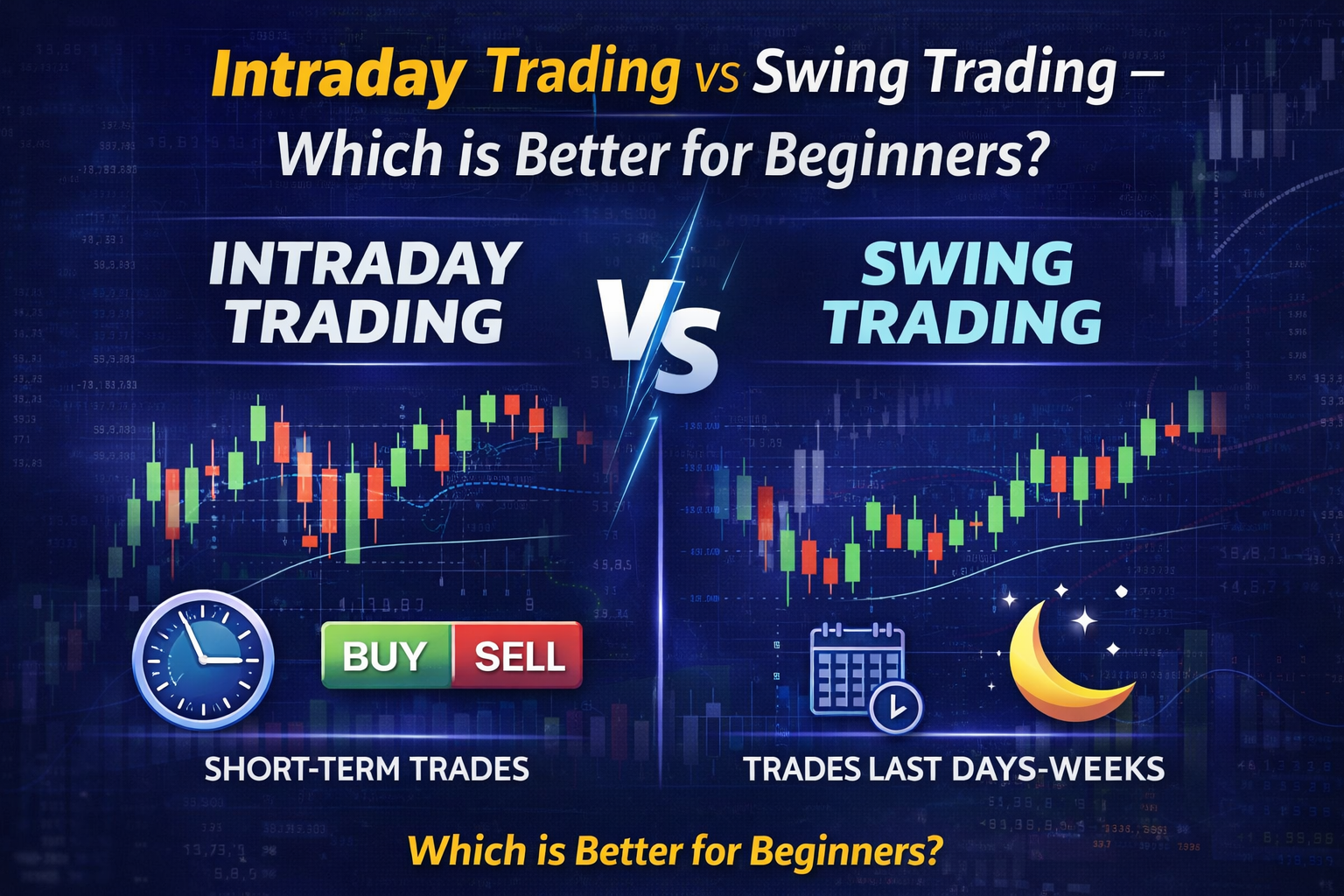
Intraday Trading vs Swing Trading – Which is Better for Beginners?
Many beginners enter the stock market with one common question: should I start with intraday trading or swing trading? Both trading styles are popular, both can be profitable, and both require discipline. But they are very different in terms of time commitment, risk level, strategy, and mindset.
Understanding the difference between intraday trading vs swing trading is important before putting money into the market. A beginner who chooses the wrong style often feels confused, takes emotional decisions, and loses confidence very quickly. That is why it is better to understand both approaches in detail before starting your trading journey.
In this guide, you will learn what intraday trading is, what swing trading is, how they differ, and which one is usually better for beginners.
What Is Intraday Trading?
Intraday trading means buying and selling a stock on the same trading day. A trader opens a position and closes it before the market closes. The goal is to capture small price movements during the day.
Intraday traders usually depend on:
- fast chart reading
- technical indicators
- market momentum
- strict stop-loss discipline
- quick decision-making
In intraday trading, timing is everything. Since positions are not carried overnight, traders avoid overnight risk, but they must stay alert throughout market hours.
This style is attractive because it offers daily opportunities. However, it also demands strong concentration, practice, and emotional control.
What Is Swing Trading?
Swing trading means holding a stock for more than one day, usually for a few days to a few weeks, to capture a larger price move.
Swing traders try to benefit from short- to medium-term trends. Instead of reacting to every small move during the day, they focus on broader setups and wait patiently for the trade to play out.
Swing trading usually involves:
- chart pattern analysis
- support and resistance levels
- trend-following setups
- holding positions for days or weeks
- less screen time than intraday trading
For many people, swing trading feels less stressful because there is more time to think, analyze, and plan.
Intraday Trading vs Swing Trading: Main Difference
The biggest difference between intraday trading vs swing trading is the holding period.
Intraday trading closes all trades on the same day. Swing trading carries trades overnight and often for several days.
That one difference changes almost everything else, including strategy, risk, time involvement, and emotional pressure.
Here is how they compare in practical terms.
1. Time Commitment
Intraday trading needs full attention during market hours. You often need to monitor charts continuously, react fast, and manage trades actively.
Swing trading needs much less screen time. Many swing traders analyze charts after market hours and place trades with pre-planned levels.
For beginners who are students, working professionals, or business owners, swing trading is often easier to manage.
2. Trade Frequency
Intraday traders may take multiple trades in one day.
Swing traders may take only a few trades in a week.
More trades do not always mean more profit. For beginners, overtrading is a common mistake in intraday trading.
3. Profit Expectations
Intraday trading usually aims for smaller moves, but more frequently.
Swing trading aims for bigger moves, but less often.
A beginner often feels attracted to fast profits in intraday trading, but quick trades also increase the chance of impulsive losses.
4. Risk Type
Intraday trading avoids overnight gap risk because positions are closed the same day.
Swing trading carries overnight risk, where news or global events can affect price gaps on the next day.
At the same time, intraday trading has high execution pressure. Swing trading has holding risk. Both have risks, but they are different.
5. Stress Level
Intraday trading is usually more stressful because decisions happen quickly.
Swing trading is generally calmer because you have more time to wait and review.
For beginners, lower stress often leads to better learning and better discipline.
Advantages of Intraday Trading
Intraday trading has some strong benefits when done properly.
Daily Opportunities
The market creates price movement every day. This gives intraday traders many chances to find setups.
No Overnight Holding
Because trades are closed on the same day, traders avoid unexpected news risk after market hours.
Faster Learning Through Repetition
Since intraday traders take more trades, they may gain market experience faster. They see more setups and more outcomes in less time.
Attractive for Full-Time Traders
People who want to make trading their main profession often explore intraday trading because it fits a daily active routine.
Disadvantages of Intraday Trading
For beginners, intraday trading also comes with major challenges.
High Emotional Pressure
Fast entries and exits can trigger fear, greed, revenge trading, and panic decisions.
Requires Constant Screen Time
You need to stay focused for long periods, which is difficult for many beginners.
Brokerage and Costs
Frequent trading can increase transaction costs and reduce net profits.
Easy to Overtrade
Because setups appear often, beginners may force trades that are not really valid.
Advantages of Swing Trading
Swing trading is often seen as a more beginner-friendly approach.
More Time to Analyze
You do not have to make decisions in seconds. You can study charts more calmly and plan trades properly.
Less Stress
Swing trading usually feels less intense than intraday trading.
Better for Working People
If you have a job, college, or business, swing trading is easier to combine with your schedule.
Captures Bigger Moves
A well-planned swing trade can capture a strong move over several days.
Disadvantages of Swing Trading
Swing trading also has limitations.
Overnight Risk
A stock can gap up or gap down due to news, earnings, or global market events.
Fewer Trade Opportunities
If you like action every day, swing trading may feel slow.
Patience Is Required
Some beginners get impatient and exit too early, even when the setup is still valid.
Which Is Better for Beginners?
For most beginners, swing trading is usually the better place to start.
That does not mean intraday trading is bad. It means swing trading often gives beginners a smoother learning curve.
Here is why swing trading is usually better for beginners:
- it needs less screen time
- it gives more time for analysis
- it reduces pressure from fast decisions
- it helps build patience and discipline
- it is easier to combine with a job or studies
Beginners often lose money in intraday trading not because the method is wrong, but because the speed is too high for their current skill level. They enter without a plan, exit in panic, and repeat mistakes too quickly.
Swing trading gives more room to think. It allows beginners to understand chart structure, trends, support and resistance, and risk management more naturally.
Can Beginners Start With Intraday Trading?
Yes, but only if they approach it seriously.
A beginner can start with intraday trading if they are ready to:
- practice on charts daily
- follow strict stop-loss rules
- avoid overtrading
- focus on one or two setups only
- spend enough time learning technical analysis
Without training and discipline, intraday trading can become expensive very quickly.
Skills Needed for Both Trading Styles
Whether you choose intraday trading or swing trading, some core skills are necessary in both.
Technical Analysis
You need to understand trend, support and resistance, candlestick patterns, and chart structure.
Risk Management
Every trade must have a stop loss, position size, and risk plan.
Trading Psychology
Control over emotions is critical. Fear and greed can damage both intraday and swing trading.
Consistency
A profitable trader follows a process. Random decisions do not create long-term results.
Beginner Mistakes in Intraday and Swing Trading
Many new traders repeat the same mistakes.
Starting Without a Plan
A trade should have entry, target, and stop loss before execution.
Taking Oversized Positions
Risking too much on one trade can destroy confidence and capital.
Ignoring Risk Management
No strategy works if losses are not controlled.
Chasing Tips
Beginners often depend on random calls instead of learning analysis.
Switching Styles Too Often
A trader who keeps jumping between intraday and swing trading usually learns neither properly.
Best Way for Beginners to Start
A practical approach for beginners is:
Start with swing trading to understand market behavior, chart reading, and risk control. Once you become more confident and disciplined, then explore intraday trading gradually.
This step-by-step approach often works better than jumping straight into fast-paced day trading.
You can also paper trade, backtest setups, and maintain a trading journal. These habits help beginners improve much faster.
Learn Trading the Right Way
If you want to understand intraday trading vs swing trading properly, the best approach is to learn from experienced mentors with a practical training system.
At Gaintaker Academy, students learn how to read charts, identify setups, manage risk, and understand which trading style suits their goals. Instead of only theory, the focus is on practical market learning, which helps beginners build confidence step by step.
A proper learning environment can save beginners from many costly mistakes.
Ready to start your trading journey with the right guidance?
Join Gaintaker Academy and learn stock market trading through practical training, live market understanding, and step-by-step mentorship. Whether you want to explore intraday trading or swing trading, our programs help beginners build a strong foundation in technical analysis, risk management, and trading discipline.
Enroll with Gaintaker Academy today and start learning trading the smart way.
FAQ
What is the main difference between intraday trading and swing trading?
The main difference is the holding period. Intraday trading closes all trades on the same day, while swing trading holds trades for several days or weeks.
Which is better for beginners, intraday trading or swing trading?
For most beginners, swing trading is usually better because it offers more time for analysis and less emotional pressure.
Is intraday trading more risky than swing trading?
Intraday trading has fast decision pressure, while swing trading has overnight risk. For beginners, intraday trading often feels riskier because of speed and emotional pressure.
Can I do swing trading with a full-time job?
Yes. Swing trading is often suitable for working professionals because it does not require continuous screen time during market hours.
Can beginners learn both intraday and swing trading?
Yes, but it is usually better to master one style first before trying both.
Where can I learn intraday and swing trading professionally?
You can learn both trading styles through practical stock market training programs at Gaintaker Academy.